
Trend Defining 2025
There is something happening in jewelry right now that sits entirely outside the conversation of investment gold and inherited stones. It is quieter than that, and in many ways more interesting. Walk through the right independent boutiques, follow the designers that the fashion crowd is genuinely excited about, scroll past the noise on social media to the accounts that actually have taste, and the same thing keeps showing up: textured brass. Considered, beautifully finished, artisan-crafted brass jewelry that looks like it belongs on a gallery shelf and costs far less than anything behind a jeweler's vitrine.
This is demi-fine's defining moment. And texture is its signature.
How We Got Here
Jewelry has long operated in absolutes. On one end sits the heirloom piece, the investment gold, the fine jewelry that carries both sentiment and financial weight. On the other sits the fast fashion accessory, designed to look good for a season and replaced without ceremony. For a long time, there was nothing credible between those two poles. No category that offered genuine craft, real aesthetic ambition, and a price point that didn't require serious deliberation.
Demi-fine changed the equation. Built on quality base metals, most often brass or sterling silver, finished with gold plating or vermeil, and designed with a level of intention you'd expect from something far more expensive, demi-fine offered consumers something they hadn't quite had before: affordable jewelry that doesn't apologize for itself.
Brands like Mejuri and Gorjana helped move the category into mainstream consciousness. But the more interesting story is happening beneath that level, in the studios of independent designers and small-batch makers who are pushing the material further. What they've consistently landed on, across continents and aesthetics, is texture. And the results are worth paying serious attention to.

Why Texture Changes Everything
There is a reason that the most enduring jewelry traditions in the world have always been rooted in surface work. Texture has historically been the marker of skill, of time spent, of value earned through craft rather than carat weight alone. What the demi-fine movement is now doing is pulling that same sensibility into a contemporary, wearable context and making it accessible.
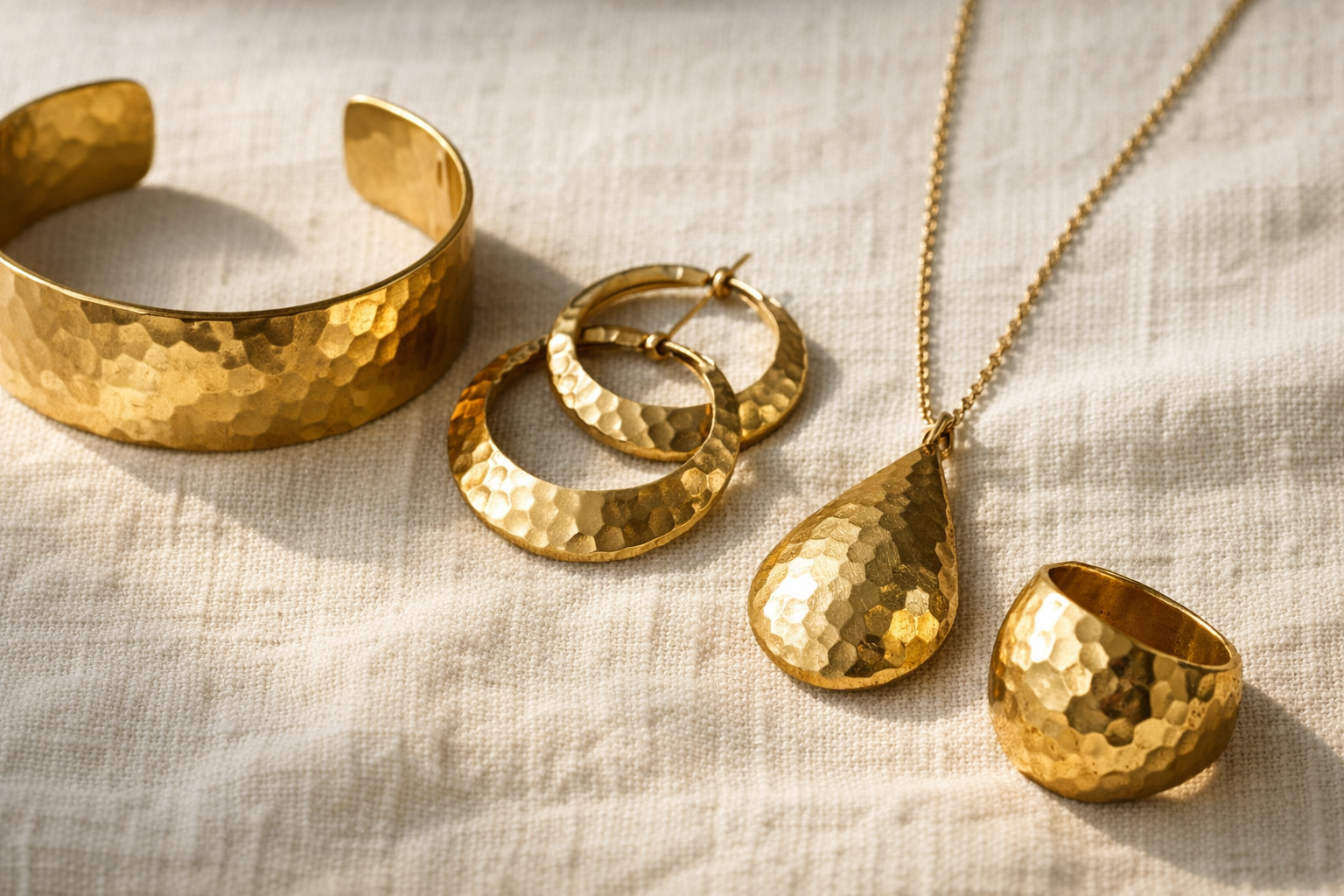
A flat, smooth surface reflects light evenly and reads as background. A textured surface does something altogether different. It creates depth, catches light unpredictably, and gives the eye something to travel across. On brass specifically, texture becomes almost architectural. Light doesn't just bounce off it, it moves across it, settles into grooves, catches differently at every angle. The result is a piece that feels alive in a way that machine-finished jewelry simply does not.

The Material Story: Why Brass Holds Texture Better Than Almost Anything Else
To understand why textured brass jewelry is having this particular moment, you have to first understand the material itself, because not every metal behaves the same way under a maker's hand, and brass behaves better than most.
Brass is an alloy, primarily copper and zinc, and its specific composition gives it a quality that jewelers describe as workability. It responds to tools with a sensitivity that harder metals simply cannot offer. When a maker strikes brass with a hammer, the metal remembers it. When a design is etched or embossed into its surface, the detail holds with a precision that doesn't fade or blur over time. This is not a coincidence of fashion. It is a material truth that craftspeople have understood for centuries.
Brass also has a particular relationship with light that sets it apart. Its warm, golden undertone means that surface texture reads with unusual richness. Shadows settle into grooves and dimples and give depth to the piece. Raised surfaces catch light and draw attention exactly where the maker intended. The interplay between the two is what gives well-crafted textured brass its almost sculptural quality. You are not just looking at jewelry. You are looking at a surface that has been deliberately considered.
Then there is the question of aging. Brass develops a patina over time, a natural oxidation process that deepens the color and enriches the surface in ways that feel earned rather than accidental. On a textured piece, this aging is particularly beautiful because it settles differently across the surface, darkening in the recesses and remaining warmer on the raised areas, creating a tonal variation that no machine can replicate. A well-made textured brass piece does not diminish with wear. In many cases it improves.
This is the quiet argument that brass makes against more expensive materials. Not that it competes with gold or silver on status, but that it offers something those metals do not always deliver: a living surface that tells the story of its own making and continues to evolve in the hands of the person wearing it.

How to Actually Judge Quality in Textured Brass Jewelry
The demi-fine market has grown fast enough that not everything in it deserves the name. Knowing how to assess what you are looking at before you buy is the difference between a piece you wear for years and one that disappoints within a season.
The first thing to understand is that weight tells you very little. Some of the most beautifully made demi-fine brass pieces are deliberately light, designed with wearability as the primary intention. A thin, lightweight piece is not a compromise. It is a design decision, made so that the jewelry moves with you rather than announcing itself, so that you can wear it through an entire day and forget it is there until you catch it in a mirror. The question is never how heavy a piece is. The question is whether its lightness feels intentional or accidental, considered or careless.
What reveals the difference is texture precision. On a genuinely well-crafted piece, the surface detail should hold its definition completely, whether the piece is fine gauge or substantial. Hammered marks should read clearly. Etched lines should be sharp and consistent. Embossed patterns should have clean edges that don't soften or blur as they approach a join or a curve. When texture starts to lose definition, particularly at the edges of a piece or near a clasp fitting, it is a sign that the making was not seen through to its conclusion.
Look closely at joins and edges next, because this is where most quality decisions reveal themselves honestly. The texture should carry through the design with intention, not stop abruptly where two pieces of metal meet. Rough or unfinished edges suggest the piece was considered only from the front, only for the first impression. That lack of consideration almost always shows elsewhere too.
The electroplating process, which is standard across quality demi-fine jewelry, does something worth understanding: it follows the surface of the metal exactly. Every hammered dimple, every etched line, every embossed curve gets sealed and finished uniformly, which means the texture is not just a visual decision but a protected one. The design integrity holds. And because brass itself is a naturally durable alloy, the foundation beneath that plating is not going anywhere either. A well-made textured brass piece is built to be worn, not preserved. It can go where your day takes you, and it holds its form and its finish across years of actual use rather than occasional outings.
Finally, run your finger across the surface. A well-finished textured brass piece should feel smooth and considered to the touch even when it is visually complex. Hammered does not mean rough. Etched does not mean sharp. The texture should invite contact, not caution. If you find burrs, uneven areas, or anything that catches uncomfortably, the finishing work was not done properly, regardless of how the piece looks in a photograph.
These are not technical criteria that require expertise to apply. They require attention and the willingness to hold something in your hand for longer than it takes to be charmed by it.

How to Wear It
The great advantage of textured brass is that it asks very little of you stylistically. A hammered cuff alongside a clean white shirt. A patina pendant layered over a fine chain with a tailored blazer. Brushed hoops worn alone, every single day, with everything. These pieces work because they carry their own character without overwhelming whatever they share an outfit with.
The one principle worth holding is restraint in volume. When a piece has strong texture, let it lead. Resist the impulse to stack heavily or create competition. Textured brass earns its place in an outfit without needing reinforcement, and the women who wear it best seem to understand instinctively that confidence in jewelry, as in most things, comes from knowing when to stop.

Why This Matters Now
The demi-fine segment represents something more culturally significant than its price point might suggest. It is jewelry for a generation of consumers making their own money, forming their own taste, and refusing the old binary between heirloom investment and throwaway fashion. They are shopping with more intention. They want fewer, better things. They want to know how something was made and by whom.
Textured brass sits at the center of that shift. It is accessible enough to invite in a wide audience, crafted enough to be taken seriously, and visually rich enough to hold its own in any context. And for those who choose to wear it lightly, to let it sit quietly on the wrist or at the collarbone without demanding attention, it offers something the louder end of the jewelry market rarely does: the confidence of a piece that knows exactly what it is.
That combination is rare in any product category. In jewelry, right now, it feels genuinely new.